Products › Cabin Filter
Cabin Filter
The cabin filter — commonly called a pollen filter — cleans the air entering the passenger cabin from outside. Its job is comfort and health, not engine protection, which is why buyers split into two tiers: a basic particle filter for cost-sensitive markets, and an activated-carbon or HEPA filter for markets where air quality is a selling point.
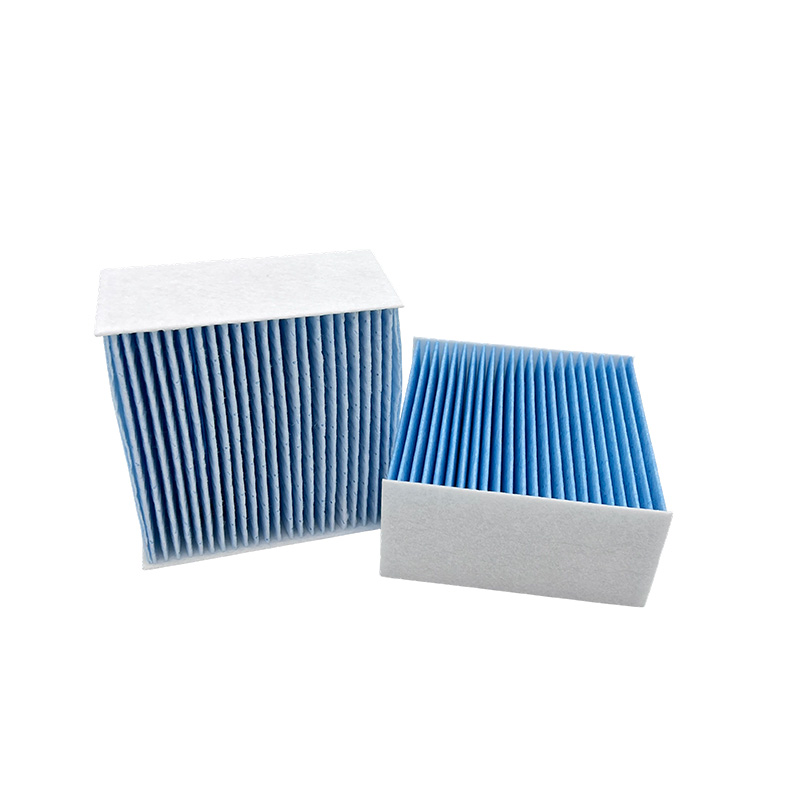
Selection Guide
Particle vs carbon vs HEPA
Particle filters stop dust and pollen; activated carbon also absorbs odors and some gases; HEPA-class media removes fine particulate for premium or allergy-conscious buyers.
Size consistency is non-negotiable
Cabin filters are rigid panels that must slide precisely into a housing — a 2–3 mm deviation means a customer complaint, so verify L×W×H against the OE housing.
Frame rigidity
A stiff plastic frame prevents the media from collapsing under blower pressure over its service life.
Market-tier the product line
Offer a particle entry SKU, a carbon mid SKU, and a HEPA top SKU so distributors can ladder pricing.
SKU Table
Canonical values (defined once in src/data/products.json). HS code: 8421310000.
| Model | Series | Dimensions | Filtration Efficiency | Media | Applicable Vehicles | Carton Qty | MOQ | Details |
|---|---|---|---|---|---|---|---|---|
| hy-cf-particle | Particle | 240mm × 200mm × H30mm | >=95% | particle | passenger cars | 25 | 1000 | View → |
| hy-cf-carbon | Carbon | 240mm × 200mm × H30mm | >=96% | activated carbon | passenger cars, SUVs | 25 | 1000 | View → |
| hy-cf-hepa | HEPA | 240mm × 200mm × H30mm | >=99.97% (H13) | HEPA composite | passenger cars, SUVs, premium vehicles | 25 | 1000 | View → |
Procurement Concerns
What a buyer should verify before committing an order in this category.
Filtration-efficiency inflation
"HEPA" and "99%" are thrown around loosely. A true HEPA claim means H13-class media at ≥99.97% for MPPS (most penetrating particle size), tested to a real standard. Distinguish particle, activated-carbon and HEPA lines on the spec sheet so your customer knows exactly what they are paying for.
Fitment & compatibility
Cabin filters are rigid panels that must slide precisely into a plastic housing. A 2–3 mm deviation means a complaint, not a discount. Confirm L×W×H against the OE housing and approve a sample before committing to a full production run.
Service life & carbon saturation
Activated carbon saturates: in polluted or heavy-traffic cities the change interval can halve. A carbon filter that has lost its adsorption is functionally a particle filter. Position a realistic change interval in your catalog so the customer reorders on a schedule, not on a failure.
Storage humidity
Activated carbon adsorbs moisture and odors from the surrounding air in storage. Keep carbon filters sealed in polybags, and never store them near solvents or fuels, or they will arrive pre-saturated and unusable.
Export packaging
Thin, wide panels bend and deform under stacking. Use rigid inner sleeves and crush-resistant cartons with stack orientation marked; a bent cabin filter will not seat and is an avoidable return.
Cabin filters are the category where an importer can most easily move a buyer from a $0.50 item to a $1.50 item, because the upgrade is a visible, sellable benefit (“cleaner cabin air”). The mistake most exporters make is listing only a particle SKU. My recommendation: always carry a carbon and a HEPA line, because urban air-quality concerns are spreading to every market we ship to — and that is a margin opportunity, not a cost.
Procurement Q&A
What is the difference between carbon and HEPA cabin filters?
Activated carbon adsorbs odors and gases; HEPA media removes a much higher share of fine particles. They are often combined in a single premium element.
What is your typical MOQ for cabin filters?
Around 1,000 units per model, with 25 units per carton. Mixed-container orders across models are supported.
Do you provide private-label packaging?
Yes, we support customer branding on inner color boxes and outer cartons, with neutral packing as the default.
What is the difference between "99%" and a true HEPA claim?
A real HEPA claim means H13-class media at ≥99.97% for the most penetrating particle size, tested to a standard. A generic "99%" without a standard and particle reference is a marketing number. We keep the three lines — particle, carbon, HEPA — clearly separated on the spec sheet.
How often should cabin filters be replaced in polluted cities?
In heavy-traffic or high-smog cities the interval can halve versus clean-air markets. We publish a realistic change interval so your customers reorder on a schedule, and carbon filters are replaced when adsorption saturates, not when they clog.
Do you combine activated carbon and HEPA in one element?
Yes — our top-tier cabin filter combines a HEPA-composite layer with activated carbon, giving fine-particle removal and odor/gas adsorption in a single premium SKU that is the easiest upsell for distributors.
Get a quote
Request a Cabin Filter quote
Send your OE number, target vehicle, or market — we match the right SKU and provide a full spec sheet.